
Pristimantis calcarulatus
| Kingdom |
Phylum |
Class |
Order |
Family |
| ANIMALIA |
CHORDATA |
AMPHIBIA |
ANURA |
STRABOMANTIDAE |
| Scientific Name: |
Pristimantis calcarulatus |
| Species Authority: |
(Lynch, 1976) |
| Synonym/s: |
Eleutherodactylus calcarulatus Lynch, 1976
|
Assessment Information
[top]
| Red List Category & Criteria: |
Vulnerable
B1ab(iii)
ver 3.1
|
| Year Published: |
2004 |
| Assessor/s: |
Fernando Castro, Santiago Ron, Luis A. Coloma, Mario Yánez-Muñoz, Diego Cisneros-Heredia |
| Reviewer/s: |
Global Amphibian Assessment Coordinating Team (Simon Stuart, Janice Chanson, Neil Cox and Bruce Young) |
| Contributor/s: |
|
Justification:
Listed as Vulnerable because its Extent of Occurrence is less than 20,000 km2, its distribution is severely fragmented, and there is continuing decline in the extent and quality of its forest habitat in Colombian and Ecuadorian Andes.
|
Geographic Range
[top]
| Range Description: |
This Andean species ranges along the western flank of the Cordillera Occidental from La Planada in the department of Nariño in extreme southern Colombia, south to Cotopaxi Province in Ecuador. Its altitudinal range is 1,140-3,000m asl. It might occur a little more widely. |
| Countries: |
|
| Range Map: |
Click here to open the map viewer and explore range. |
Population
[top]
| Population: |
It is a very common species.
|
| Population Trend: |
Decreasing
|
Habitat and Ecology
[top]
| Habitat and Ecology: |
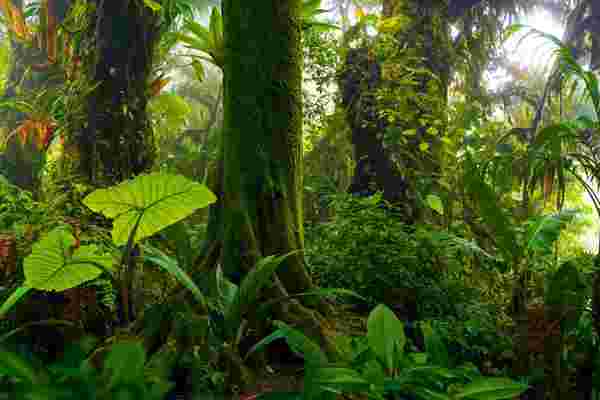
It inhabits primary and secondary forest, and does not occur in open areas. It is arboreal in bushes and trees, and is associated with epiphytes in high vegetation. It is especially abundant along trails through cloud forest, particularly in the proximity of small streams. It breeds by direct development, and the eggs are deposited in leaf-litter.
|
| Systems: |
Terrestrial; Freshwater |
| Major Threat(s): |
The major threats are likely to be deforestation for agricultural development (including plantations, and the planting of illegal crops), logging, and human settlement, and pollution resulting from the spraying of illegal crops. Some other species of Eleutherodactylus that are associated with streams at high elevations have undergone dramatic declines and disappearances, possibly due to chytridiomycosis, so the status of this species should be monitored carefully.
|
Conservation Actions
[top]
| Conservation Actions: |
In Ecuador, its geographic range overlaps with the Reserva Ecológica Cotacachi-Cayapas and the Reserva Ecológica Los Illinizas. In Colombia it occurs in the La Planda private reserve.
|