


| Kingdom | Phylum | Class | Order | Family |
|---|---|---|---|---|
| ANIMALIA | CHORDATA | AMPHIBIA | ANURA | HYLIDAE |
| Scientific Name: | Trachycephalus venulosus | |||
| Species Authority: | (Laurenti, 1768) | |||
Common Name/s:
|
||||
| Synonym/s: |
Argenteohyla altamazonica Henle, 1981
Hyla adenoderma B. Lutz, 1968
Hyla macrotis Andersson, 1945
Hyla tibiatrix Laurenti, 1768
Hyla zonata Spix, 1824
Phrynohyas corasterias Shannon and Humphrey, 1957
Phrynohyas ingens Duellman, 1956
Phrynohyas latifasciata Duellman, 1956
Rana venulosa Laurenti, 1768
|
|||
| Taxonomic Notes: | This species was previously within the genus Phrynohyas which was recently synonymized with Trachycephalus (Faivovich, et al., 2005). | |||
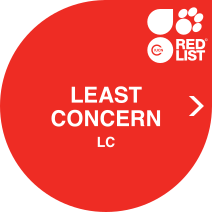
| Red List Category & Criteria: | Least Concern ver 3.1 | |||
| Year Published: | 2010 | |||
| Assessor/s: | Enrique La Marca, Claudia Azevedo-Ramos, Norman Scott, Lucy Aquino, Débora Silvano, Luis A. Coloma, Santiago Ron, Julian Faivovich, Georgina Santos-Barrera, Frank Solís, Roberto Ibáñez, Federico Bolaños, Larry David Wilson, Jerry Hardy, Paulino Ponce | |||
| Reviewer/s: | Global Amphibian Assessment Coordinating Team (Simon Stuart, Janice Chanson, Neil Cox and Bruce Young) | |||
| Contributor/s: | ||||
|
Justification: Listed as Least Concern in view of its wide distribution, tolerance of a broad range of habitats, presumed large population, and because it is unlikely to be declining to qualify for listing in a more threatened category. |
||||
| History: |
|
|||
| Range Description: | This species is found in Central America, from central Tamaulipas and southern Sinaloa, Mexico southward on both coasts to central Nicaragua and on to the Pacific lowlands through Panama, from 0-1,610m asl. In South America it occurs throughout the Amazon basin, south to Paraná (Brazil), Paraguay, northern Argentina. It is also present on both Trinidad and Tobago. It has an altitudinal range in South America of sea level to 800m asl. |
| Countries: | Native: Argentina; Belize; Bolivia, Plurinational States of; Brazil; Colombia; Costa Rica; Ecuador; El Salvador; French Guiana; Guatemala; Guyana; Honduras; Mexico; Nicaragua; Panama; Paraguay; Peru; Suriname; Trinidad and Tobago; Venezuela |
| Range Map: | Click here to open the map viewer and explore range. |
| Population: | It is a very common species. |
| Population Trend: |
Stable
|
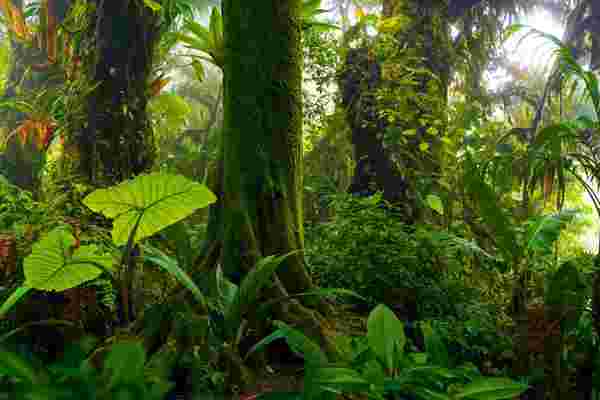
| Habitat and Ecology: | This is an arboreal, canopy-dwelling forest and forest-edge species. It occurs in a number of habitat types from savannahs and other open habitats to both dry and moist forests. It can be found in disturbed habitats, animals may even be found within human dwellings. It can live within second growth forest and plantations. This species breeds at the beginning of the rainy season, with males calling at night while floating in large temporary pools or intermittent streams. The floating egg clutches are laid in the water where the tadpoles also develop. |
| Systems: | Terrestrial; Freshwater |
| Major Threat(s): | There are no major threats, this is a widespread species with large areas of suitable habitat remaining. There is some localized habitat loss due to drying of wetlands, forest destruction, urbanization, pollution and fire. It is sometimes found in the international pet trade but at levels that do not currently constitute a major threat. |
| Conservation Actions: | The wide distribution range of this species overlaps with several protected areas. |
| Citation: | Enrique La Marca, Claudia Azevedo-Ramos, Norman Scott, Lucy Aquino, Débora Silvano, Luis A. Coloma, Santiago Ron, Julian Faivovich, Georgina Santos-Barrera, Frank Solís, Roberto Ibáñez, Federico Bolaños, Larry David Wilson, Jerry Hardy, Paulino Ponce 2010. Trachycephalus venulosus. In: IUCN 2012. IUCN Red List of Threatened Species. Version 2012.2. <www.iucnredlist.org>. Downloaded on 23 May 2013. |
| Disclaimer: | To make use of this information, please check the <Terms of Use>. |
| Feedback: | If you see any errors or have any questions or suggestions on what is shown on this page, please fill in the feedback form so that we can correct or extend the information provided |