


| Kingdom | Phylum | Class | Order | Family |
|---|---|---|---|---|
| ANIMALIA | CHORDATA | AMPHIBIA | ANURA | HYLIDAE |
| Scientific Name: | Agalychnis spurrelli | |||
| Species Authority: | Boulenger, 1913 | |||
Common Name/s:
|
||||
| Taxonomic Notes: | More than one species may currently be included within Agalychnis spurrelli (Federico Bolaños pers. comm.). | |||
| Red List Category & Criteria: | Least Concern ver 3.1 |
| Year Published: | 2004 |
| Assessor/s: | Karl-Heinz Jungfer, Wilmar Bolívar, Brian Kubicki, Federico Bolaños, Gerardo Chaves, Frank Solís, Roberto Ibáñez, Jay Savage, César Jaramillo, Querube Fuenmayor |
| Reviewer/s: | Global Amphibian Assessment Coordinating Team (Simon Stuart, Janice Chanson, Neil Cox and Bruce Young) |
| Contributor/s: | |
|
Justification: Listed as Least Concern in view of its wide distribution, presumed large population, and because it is unlikely to be declining fast enough to qualify for listing in a more threatened category. |
|
| Range Description: | This species ranges widely in the humid lowlands and lower portions of the premontane zone of southeastern and southwestern Costa Rica, through Panama and the Pacific lowlands of Colombia to northwestern Ecuador. Its altitudinal range is 15-750m. |
| Countries: | Native: Colombia; Costa Rica; Ecuador; Panama |
| Range Map: | Click here to open the map viewer and explore range. |
| Population: | This species is rarely seen because of its arboreal habits. It abundance is unclear. |
| Population Trend: |
Decreasing
|
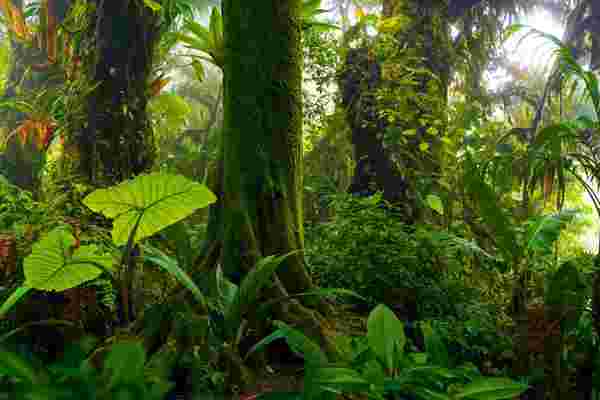
| Habitat and Ecology: | It is a nocturnal canopy species of undisturbed humid lowland forest. Explosive breeding takes place in temporary rain pools without fish following, or during, heavy rains. Eggs are deposited on the upper-surfaces of leaves, 1.5-8m above the water. Hatching tadpoles fall into the water below. |
| Systems: | Terrestrial; Freshwater |
| Major Threat(s): | The major threats are deforestation for agricultural development, illegal crops, logging, and human settlement, and pollution resulting from the spraying of illegal crops. The known localities in Ecuador are facing considerable human pressure. Museum specimens of this species have been found to be infected with chytridiomycosis, but the current impact of this pathogen on the species in the wild is not known. |
| Conservation Actions: |
It has been recorded from a number of protected areas, including at least three in Panama and three in Costa Rica. In Ecuador, its geographic range overlaps with Reserva Ecológica Cotacachi-Cayapas, but it is not confirmed from any protected areas in Colombia. It is listed on CITES Appendix II. |
| Citation: | Karl-Heinz Jungfer, Wilmar Bolívar, Brian Kubicki, Federico Bolaños, Gerardo Chaves, Frank Solís, Roberto Ibáñez, Jay Savage, César Jaramillo, Querube Fuenmayor 2004. Agalychnis spurrelli. In: IUCN 2012. IUCN Red List of Threatened Species. Version 2012.2. <www.iucnredlist.org>. Downloaded on 25 May 2013. |
| Disclaimer: | To make use of this information, please check the <Terms of Use>. |
| Feedback: | If you see any errors or have any questions or suggestions on what is shown on this page, please fill in the feedback form so that we can correct or extend the information provided |