
Hyalinobatrachium colymbiphyllum
| Kingdom |
Phylum |
Class |
Order |
Family |
| ANIMALIA |
CHORDATA |
AMPHIBIA |
ANURA |
CENTROLENIDAE |
| Scientific Name: |
Hyalinobatrachium colymbiphyllum |
| Species Authority: |
(Taylor, 1949) |
Common Name/s:
| Spanish |
– |
Ranita De Cristal |
|
| Taxonomic Notes: |
Taxonomic revision of this species is needed, with the population in Monteverde, Costa Rica, possibly representing an undescribed species (Brian Kubicki pers. comm.). |
Assessment Information
[top]
| Red List Category & Criteria: |
Least Concern
ver 3.1
|
| Year Published: |
2004 |
| Assessor/s: |
Frank Solís, Roberto Ibáñez, Gerardo Chaves, Jay Savage, César Jaramillo, Querube Fuenmayor, Fernando Castro, Taran Grant, Erik Wild, Andrés Acosta-Galvis, Brian Kubicki |
| Reviewer/s: |
Global Amphibian Assessment Coordinating Team (Simon Stuart, Janice Chanson, Neil Cox and Bruce Young) |
| Contributor/s: |
|
Justification:
Listed as Least Concern in view of its wide distribution, presumed large population, and because it is unlikely to be declining fast enough to qualify for listing in a more threatened category.
|
Geographic Range
[top]
| Range Description: |
This species is known from the humid lowlands, premontane slopes, and lower areas of the lower montane belt of the Atlantic slope of Costa Rica, and the Pacific slope marginally in northwestern Costa Rica and from southwestern Costa Rica also on the Atlantic versant in central Panama (up to 1,580m asl). Some records from the Caribbean slope of Costa Rica may refer to Hyalinobatrachium chirripoi (Brian Kubicki pers. comm.). In Colombia it is known from Tolima, Caldas, Boyaca, Cordoba, Antioquia, Risaralda, Choco and Valle del Cauca departments up to 1,800m asl. |
| Countries: |
Native: Colombia; Costa Rica; Panama |
| Range Map: |
Click here to open the map viewer and explore range. |
Population
[top]
| Population: |
It is generally a common species throughout its range. The population declined drastically in Monteverde, Costa Rica, by early in the 1990s, but it has since partially recovered.
|
| Population Trend: |
Stable
|
Habitat and Ecology
[top]
| Habitat and Ecology: |
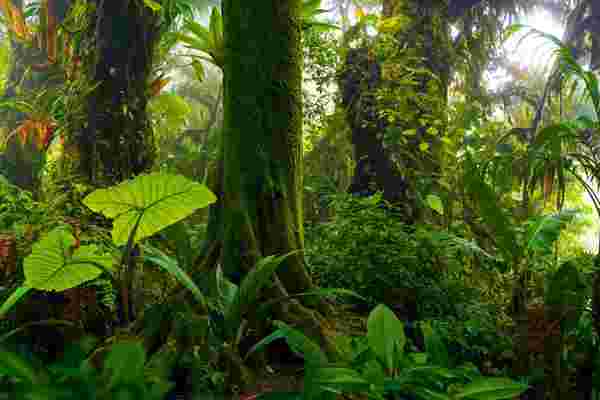
It inhabits humid lowland and montane forest, and is observed in bushes and trees along forest streams. The larvae develop in these streams. It is restricted to the vegetation over the streams.
|
| Systems: |
Terrestrial; Freshwater |
| Major Threat(s): |
General habitat loss due to the destruction of natural forests is a localized threat, but there are no major threats to the species overall survival at present.
|
Conservation Actions
[top]
| Conservation Actions: |
The species has been recorded from a number of protected areas throughout its range.
|