


| Kingdom | Phylum | Class | Order | Family |
|---|---|---|---|---|
| ANIMALIA | CHORDATA | CHONDRICHTHYES | RAJIFORMES | DASYATIDAE |
| Scientific Name: | Taeniura lymma | |||
| Species Authority: | (Forsskael, 1775) | |||
Common Name/s:
|
||||
| Synonym/s: |
Raja lymma Forsskål, 1775
|
|||
| Red List Category & Criteria: | Near Threatened ver 3.1 |
| Year Published: | 2005 |
| Assessor/s: | Compagno, L.J.V. |
| Reviewer/s: | Musick, J.A. & Fowler, S.L. (Shark Red List Authority) |
| Contributor/s: | |
|
Justification: This assessment is based on the information published in the 2005 shark status survey (Fowler et al. 2005). Although very wide ranging and common, the Ribbontailed Stingray (Taeniura lymma) is subject to human-induced problems because of heavy inshore fisheries in most places where it occurs, its attractiveness for the marine aquarium fish trade (small size and brilliant colour pattern) and, especially, by widespread destruction of its reef habitat. |
|
| Range Description: | Widespread in the Indo-West Pacific, including South Africa, Mozambique, Madagascar, Mauritius, Seychelles, Tanzania (Zanzibar), Kenya, Red Sea (Lohaja and Massaua), Saudi Arabia, Gulf of Aden, Gulf of Oman, Persian Gulf, Pakistan, India, Sri Lanka, Myanmar, Malaysia, Singapore, Indonesia, Thailand, Vietnam, the Philippines, Papua New Guinea, the Solomons, Australia, Melanesia and Polynesia (Fowler 1941, Herre 1953, Last and Stevens 1994, Last and Compagno 1999). No information exists on subpopulations. |
| Countries: | Native: American Samoa (American Samoa); Australia; Bahrain; Cook Islands; Eritrea; Fiji; French Polynesia; India; Indonesia; Kenya; Madagascar; Malaysia; Mauritius; Mozambique; Myanmar; New Caledonia; New Zealand; Niue; Norfolk Island; Oman; Pakistan; Papua New Guinea; Philippines; Pitcairn; Qatar; Samoa; Saudi Arabia; Seychelles; Singapore; Solomon Islands; Somalia; South Africa; Sri Lanka; Sudan; Tanzania, United Republic of; Thailand; Tokelau; Tonga; Tuvalu; United Arab Emirates; United States (Hawaiian Is.); Vanuatu; Viet Nam; Wallis and Futuna; Yemen |
| FAO Marine Fishing Areas: | Native:
Indian Ocean – eastern; Indian Ocean – western; Pacific – western central
|
| Range Map: | Click here to open the map viewer and explore range. |
| Population Trend: |
Unknown
|
| Habitat and Ecology: |
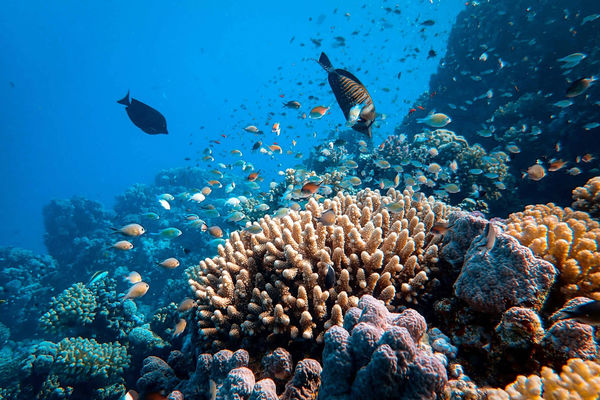
A small stingray characteristic of coral reef habitats. Also found foraging near seagrass patches (Yahya and Jiddawi pers. comm.). Moves with rising tide into shallow, sandy areas to feed on molluscs, and shelters in caves and under ledges when the tide falls (Last and Stevens 1994). Despite its relative abundance in some areas, almost no information is available on its life history parameters (age at maturity, longevity, average reproductive age, generation time and annual fecundity are all unknown). |
| Systems: | Marine |
| Major Threat(s): | This ray is commonly taken where heavy artisanal and small-scale commercial fisheries occur in or around coral reef habitats. Additionally, it may possibly be exploited locally for capture for the marine aquarium trade. It is at risk in many areas because of its dependence on coral reef habitats. These are under massive assault from net, dynamite and cyanide fisheries for teleosts in many places where the species occurs. In East Africa, artisanal fishers catch T. lymna using bottom¬set gillnets, longlines and skin-diving with spears, and also as bycatch in fence traps (S. Yahya and N. Jiddawi pers. obs.). Habitat loss and degradation therefore likely exert a significant impact on populations. |
| Conservation Actions: | No conservation or management initiatives have been identified. |
| Citation: | Compagno, L.J.V. 2005. Taeniura lymma. In: IUCN 2012. IUCN Red List of Threatened Species. Version 2012.2. <www.iucnredlist.org>. Downloaded on 20 May 2013. |
| Disclaimer: | To make use of this information, please check the <Terms of Use>. |
| Feedback: | If you see any errors or have any questions or suggestions on what is shown on this page, please fill in the feedback form so that we can correct or extend the information provided |