

Map_thumbnail_large_font

Saltator rufiventris

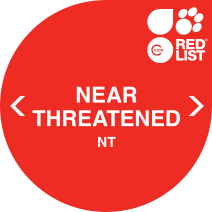
Status_ne_offStatus_dd_offStatus_lc_offStatus_nt_onStatus_vu_offStatus_en_offStatus_cr_offStatus_ew_offStatus_ex_off

Taxonomy [top]

Kingdom Phylum Class Order Family
ANIMALIA CHORDATA AVES PASSERIFORMES CARDINALIDAE

Scientific Name: Saltator rufiventris
Species Authority: d'Orbigny & Lafresnaye, 1837
Common Name/s:
English Rufous-bellied Saltator

Assessment Information [top]

Red List Category & Criteria: Near Threatened ver 3.1
Year Published: 2012
Assessor/s: BirdLife International
Reviewer/s: Butchart, S. & Symes, A.
Contributor/s: Hjarsen, T. & Mayer, S.
Justification:
This localised species is listed as Near Threatened as it is thought to have a relatively small, fragmented population which is declining owing to habitat loss (Collar et al. 1992).

History:
2008 Near Threatened
2004 Near Threatened
1996 Vulnerable
1994 Vulnerable

Geographic Range [top]

Range Description: Saltator rufiventris occurs in the east Andes of La Paz, Cochabamba, Potosí, Chuquisaca, Tarija, Bolivia and Jujuy and Salta in Argentina. It is very local outside Cochabamba, but increased field effort has resulted in discoveries at several new sites (Fjeldså and Mayer 1996, Pearman 1997, Mazar Barnett et al. 1998a), and it is expected that further surveys will find it at new localities. It is common at some sites in Cochabamba and one area in La Paz (Pearman 1997, S. Mayer in litt. 1999), with the total population thought to exceed 10,000 birds (S. Mayer in litt. 1999).

Countries:
Native:
Argentina; Bolivia, Plurinational States of
Range Map: Click here to open the map viewer and explore range.

Population [top]

Population: The global population size has not been quantified, but this species is described as 'uncommon' (Stotz et al. 1996).
Population Trend: Decreasing

Habitat and Ecology [top]

Habitat and Ecology: This species inhabits the temperate zone at 2,500-4,000 m in shrubby or open habitats (including agricultural land) with patches of scrub, Polylepis or Alnus woodland (Remsen et al. 1988, Fjeldså and Mayer 1996, Pearman 1997, Mazar Barnett et al. 1998a). It may be reliant on habitat patches comprising native tree species (S. Mayer in litt. 1999).

Systems: Terrestrial

Threats [top]

Major Threat(s): Scrub and native woodland patches are being fragmented and converted to agricultural and commercial forest land-uses within this species's range (Remsen et al. 1988, Rocha and Quiroga 1996, Mazar Barnett et al. 1998a, T. Hjarsen in litt. 1999), probably resulting in some population declines.

Conservation Actions [top]

Conservation Actions: Conservation Actions Underway
Conservation Actions Proposed
Conduct further studies to identify habitat requirements, particularly the extent of reliance on native tree species. Survey areas surrounding the known range to determine the full extent of the distribution. Monitor known sites to measure rates of population decline and identify threats. Effectively protect significant areas of suitable habitat, including patches of native tree species, at key sites, in both strictly protected areas and community led multiple use areas.

Citation: BirdLife International 2012. Saltator rufiventris. In: IUCN 2012. IUCN Red List of Threatened Species. Version 2012.2. <www.iucnredlist.org>. Downloaded on 23 May 2013.
Disclaimer: To make use of this information, please check the <Terms of Use>.
Feedback: If you see any errors or have any questions or suggestions on what is shown on this page, please fill in the feedback form so that we can correct or extend the information provided