


| Kingdom | Phylum | Class | Order | Family |
|---|---|---|---|---|
| ANIMALIA | CHORDATA | AVES | PASSERIFORMES | SYLVIIDAE |
| Scientific Name: | Acrocephalus kerearako | |||
| Species Authority: | Holyoak, 1974 | |||
Common Name/s:
|
||||
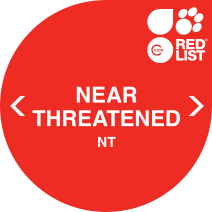
| Red List Category & Criteria: | Near Threatened ver 3.1 | ||||||
| Year Published: | 2012 | ||||||
| Assessor/s: | BirdLife International | ||||||
| Reviewer/s: | Butchart, S. & Symes, A. | ||||||
| Contributor/s: | |||||||
|
Justification: This species qualifies as Near Threatened because although it is currently considered common where it occurs, it has a moderately small range and as such is capable of becoming threatened in a very short time. It may be declining due to predation by introduced species. |
|||||||
| History: |
|
||||||
| Range Description: | Acrocephalus kerearako remains common on the two tiny islands of Mangaia and Miti'aro, Cook Islands (McCormack 1997). |
| Countries: | Native: Cook Islands |
| Range Map: | Click here to open the map viewer and explore range. |
| Population: | The global population size has not been quantified, but the species is described as still common and numerous on both islands in its range (del Hoyo et al. 2006). |
| Population Trend: |
Decreasing
|
| Habitat and Ecology: | It inhabits a variety of habitats including reeds, gardens and woodland (Pratt et al. 1987). |
| Systems: | Terrestrial; Freshwater |
| Major Threat(s): | On Mangaia, there are a variety of introduced species including the aggressive Common Myna Acridotheres tristis (numbering c.9,000 birds), cats and rats (both Pacific rat Rattus exulans and black rat R. rattus), and clearance for agriculture and browsing by goats causes habitat loss and fragmentation (Rowe and Empson 1996). |
| Conservation Actions: |
Conservation Actions Underway The feasibility of eradicating A. tristis has been evaluated; it is thought possible at the cost of $100,000 and has the support of local people. Conservation Actions Proposed Carry out a survey to determine population size so that future trends can be revealed. Implement the planned eradication of A. tristis on Mangaia. Train local people in animal husbandry techniques which will minimise negative impacts on the forest. Set aside and protect an area of forest on each island. Investigate the taxonomic status of the populations on the two islands. |
| Citation: | BirdLife International 2012. Acrocephalus kerearako. In: IUCN 2012. IUCN Red List of Threatened Species. Version 2012.2. <www.iucnredlist.org>. Downloaded on 23 May 2013. |
| Disclaimer: | To make use of this information, please check the <Terms of Use>. |
| Feedback: | If you see any errors or have any questions or suggestions on what is shown on this page, please fill in the feedback form so that we can correct or extend the information provided |