



| Kingdom | Phylum | Class | Order | Family |
|---|---|---|---|---|
| ANIMALIA | CHORDATA | AVES | PASSERIFORMES | TYRANNIDAE |
| Scientific Name: | Contopus cooperi | |||
| Species Authority: | (Swainson, 1832) | |||
Common Name/s:
|
||||
| Taxonomic Notes: | Use of the specific name cooperi rather than borealis follows AOU (1998). | |||
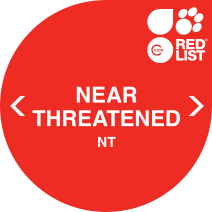
| Red List Category & Criteria: | Near Threatened ver 3.1 | ||||||
| Year Published: | 2012 | ||||||
| Assessor/s: | BirdLife International | ||||||
| Reviewer/s: | Butchart, S. & Symes, A. | ||||||
| Contributor/s: | Butcher, G., Rosenberg, K. & Wells, J. | ||||||
|
Justification: The species has undergone a moderately rapid decline and therefore qualifies as as Near Threatened. |
|||||||
| History: |
|
||||||
| Range Description: | Contopus cooperi breeds across Canada (overlapping into eastern USA) and Alaska, and down the west coast of the USA as far as northern Mexico. There are also isolated populations in several states in the eastern USA (Altman and Sallabanks 2000). It winters primarily in Panama and the Andes Mountains, from north and west Venezuela south through Ecuador to south-east Peru and west Bolivia (Altman and Sallabanks 2000). Casual wintering also occurs in the Guianas, Trinidad, south Venezuela, Brazil and south Peru (Altman and Sallabanks 2000). Based on data from the Breeding Bird Survey the population has declined by 3.5% annually since 1980, equating to a 30% decline over a ten year period, but a 20.6% decline for the period 1993-2002. Given the apparent benefits to the species of some forest management practices in north America, populations may be being affected by loss or alteration of habitat in their wintering grounds. |
| Countries: |
Native: Belize; Bolivia, Plurinational States of; Bonaire, Sint Eustatius and Saba; Brazil; Canada; Colombia; Costa Rica; Curaçao; Ecuador; El Salvador; French Guiana; Guatemala; Guyana; Honduras; Mexico; Nicaragua; Panama; Peru; Saint Pierre and Miquelon; Sint Maarten (Dutch part); Suriname; Trinidad and Tobago; United States; VenezuelaVagrant: Greenland |
| Range Map: | Click here to open the map viewer and explore range. |
| Population: | Rich et al. (2004). |
| Population Trend: |
Decreasing
|
| Habitat and Ecology: | It breeds along forest edges and openings, semi-open forest, water edges and harvested forest where some structure has been retained. Prominent trees serve as singing and foraging posts, and both sexes are aggressively territorial (Altman and Sallabanks 2000). |
| Systems: | Terrestrial; Freshwater |
| Major Threat(s): | Habitat loss and alteration of forest management practices may limit breeding success (Altman 1997). However, numerous studies suggest that several types of harvested forest are beneficial to the species (possibly recreating preferred post-forest fire habitat mosaics) (Altman and Sallabanks 2000). Unknown threats may be affecting the species on its wintering grounds. |
| Conservation Actions: |
Conservation Actions Underway No species specific actions are known. Conservation Actions Proposed Identify causes behind the declines. Develop and implement relevant actions once this first step has been completed. |
| Citation: | BirdLife International 2012. Contopus cooperi. In: IUCN 2012. IUCN Red List of Threatened Species. Version 2012.2. <www.iucnredlist.org>. Downloaded on 24 May 2013. |
| Disclaimer: | To make use of this information, please check the <Terms of Use>. |
| Feedback: | If you see any errors or have any questions or suggestions on what is shown on this page, please fill in the feedback form so that we can correct or extend the information provided |