
Pseudocalyptomena graueri
| Kingdom |
Phylum |
Class |
Order |
Family |
| ANIMALIA |
CHORDATA |
AVES |
PASSERIFORMES |
EURYLAIMIDAE |
| Scientific Name: |
Pseudocalyptomena graueri |
| Species Authority: |
Rothschild, 1909 |
Common Name/s:
| English |
– |
African Green Broadbill, Grauer's Broadbill |
| French |
– |
Eurylaime de Grauer |
|
Assessment Information
[top]
| Red List Category & Criteria: |
Vulnerable
B1ab(i,ii,iii,v);C2a(i)
ver 3.1
|
| Year Published: |
2012 |
| Assessor/s: |
BirdLife International |
| Reviewer/s: |
Butchart, S. & Taylor, J. |
| Contributor/s: |
Butynski, T., Carswell, M. & Plumptre, A. |
Justification:
This species has a small and fragmented range, within which its montane forest habitat continues to be degraded and cleared. Therefore it is likely to have a small and declining population, and is classified as Vulnerable.
|
| History: |
| 2008 |
– |
Vulnerable
|
| 2004 |
– |
Vulnerable
|
| 2000 |
– |
Vulnerable
|
| 1996 |
– |
Vulnerable
|
| 1994 |
– |
Vulnerable
|
|
Geographic Range
[top]
| Range Description: |
Pseudocalyptomena graueri is known from only two areas in the eastern Democratic Republic of Congo, the Itombwe Mountains and the mountains west of Lake Kivu, and one area in south-west Uganda, Bwindi (Impenetrable) Forest. The species is not considered common in Bwindi Forest, where density is probably one per km2, and recent surveys have been unsuccessful in locating the species in Kahuzi-Biéga National Park (A. Plumptre in litt. 2007).
|
| Countries: |
Native: Congo, The Democratic Republic of the; Uganda |
| Range Map: |
Click here to open the map viewer and explore range. |
Population
[top]
| Population: |
The population is estimated to number 2,500-9,999 mature individuals based on an assessment of known records, descriptions of abundance and range size. This is consistent with recorded population density estimates for congeners or close relatives with a similar body size, and the fact that only a proportion of the estimated Extent of Occurrence is likely to be occupied. This estimate is equivalent to 3,750-14,999 individuals, rounded here to 3,500-15,000 individuals.
|
| Population Trend: |
Decreasing
|
Habitat and Ecology
[top]
| Habitat and Ecology: |
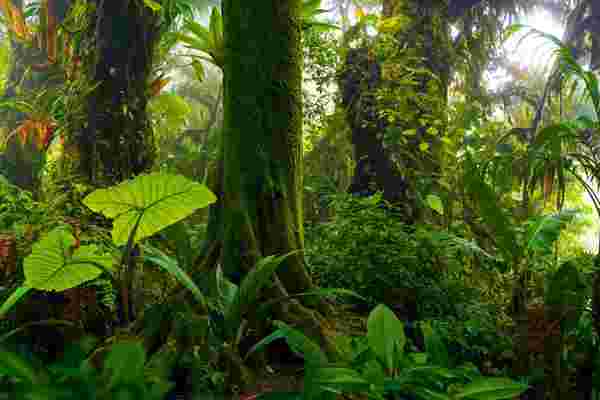
It inhabits primary rainforest (up to 20 m off ground, but usually in middle strata in Bwindi), and also occurs in forest edge and isolated trees in cleared ground (Keith et al. 1992, M. Carswell in litt. 1999). It feeds on seeds, flowers, buds, fruit, beetles, larvae and snails (Keith et al. 1992). The only recorded nest was found 11 m up in a 20 m tree in the outermost branches overhanging a stream, situated in a valley floor with open shrubby vegetation (Keith et al. 1992). At Bwindi, fledged young were being fed in March (M. Carswell in litt. 1999).
|
| Systems: |
Terrestrial |
| Major Threat(s): |
Deforestation and forest degradation are the most likely threats throughout its range. Forest in the Itombwe Mountains and Kahuzi-Biéga is under increasing pressure from pastoralists, farmers, pit-sawyers, miners and hunters (Butynski et al. 1997, Hall et al. 1998, Omari et al. 1999). The human population in this volatile area is increasing rapidly and thousands of refugees from Burundi and Rwanda live in camps at the base of Itombwe's eastern escarpment and to the north (Butynski et al. 1997, Hall et al. 1998, Omari et al. 1999). Clearance for agriculture, particularly along the southern and western edges of gallery montane forest, has increased dramatically in the past few years as maize crops have failed, causing famine (Butynski et al. 1997).
|
Conservation Actions
[top]
| Conservation Actions: |
Conservation Actions Underway It is very well-protected in Bwindi-Impenetrable National Park (T. Butynski in litt. 1999). The Kahuzi-Biéga National Park embraces much habitat west of Lake Kivu, but is under threat (Hall et al. 1998), and the Itombwe Mountains are not protected.
Conservation Actions Proposed Evaluate its distribution and status within the projected range, once the security situation permits this. Carry out regular surveys to monitor population trends, once the security situation is conducive. Monitor rates of habitat loss and degradation within its projected range. As and when feasible, increase efforts to effectively protect Kahuzi-Biéga National Park. Increase the area of suitable habitat that has protected status, particularly in the Itombwe Mountains.
|