



| Kingdom | Phylum | Class | Order | Family |
|---|---|---|---|---|
| ANIMALIA | CHORDATA | AVES | FALCONIFORMES | ACCIPITRIDAE |
| Scientific Name: | Harpia harpyja | ||||||
| Species Authority: | (Linnaeus, 1758) | ||||||
Common Name/s:
|
|||||||
| Red List Category & Criteria: | Near Threatened ver 3.1 | ||||||
| Year Published: | 2012 | ||||||
| Assessor/s: | BirdLife International | ||||||
| Reviewer/s: | Butchart, S. & Symes, A. | ||||||
| Contributor/s: | Lloyd, H. & Miller, B. | ||||||
|
Justification: This species is classified as Near Threatened because it is suspected to be declining moderately rapidly owing to hunting and habitat loss. |
|||||||
| History: |
|
||||||
| Range Description: | Harpia harpyja is sparsely distributed and generally rare throughout its extensive range in south Mexico, Guatemala, Belize (recently confirmed [B. W. Miller in litt. 2000]), Honduras, Nicaragua, Costa Rica, Panama (including four birds introduced in 1998 [Bell 1998]), Colombia, Venezuela, Guyana, Suriname, French Guiana (perhaps 200-400 pairs [Thiollay 1985b]), Ecuador, Peru, Bolivia, Brazil, Paraguay and north-east Argentina (Misiones, but formerly Formosa, Salta and Jujuy [Chebez 1994, Chebez et al. 1995, Vargas et al. 2006]). It is thought to be locally or regionally extinct in large parts of its former range, notably most of central and north Central America and possibly Rio Grande do Sul, Brazil (Bierregaard 1994a, Bierregaard et al. 1995), but recent records suggest that the population in the southern Atlantic forests may be migratory (Galetti et al. 1997b). |
| Countries: | Native: Argentina; Belize; Bolivia, Plurinational States of; Brazil; Colombia; Costa Rica; Ecuador; French Guiana; Guatemala; Guyana; Honduras; Mexico; Nicaragua; Panama; Paraguay; Peru; Suriname; Venezuela |
| Range Map: | Click here to open the map viewer and explore range. |
| Population: | Partners in Flight estimated the population to number fewer than 50,000 individuals (A. Panjabi in litt. 2008), thus it is placed in the band 20,000-49,999 individuals here. |
| Population Trend: |
Decreasing
|
| Habitat and Ecology: |
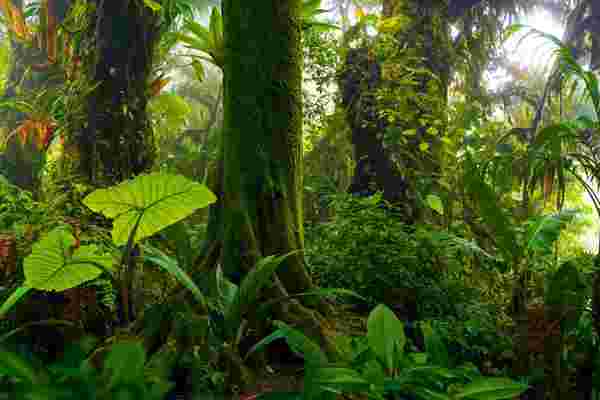
It occurs in uninterrupted expanses of lowland tropical forest (typically below 900 m but locally to 2,000 m), but will nest where high-grade forestry has been practised, and use forest patches within a pasture/forest mosaic for hunting (Bierregaard 1994a, Parker et al. 1996). Nests have been reported only 3 km apart in Panama and Guyana (Bierregaard 1994a). |
| Systems: | Terrestrial |
| Major Threat(s): | Although still reasonably common in the Amazonian forests of Brazil and Peru (H. Lloyd in litt. 1999), it will only survive in the long term if the escalating rate of forest destruction in the region is brought under control and a network of inviolate reserves established (Malingreau and Tucker 1988, Bierregaard 1994a). Low overall population densities and slow reproductive rates make shooting the most significant threat over its entire range (Bierregaard 1994a, Bierregaard et al. 1995). It could perhaps survive in disturbed forests or even forest mosaics if its large size and boldness in the face of humans did not make it an irresistible target for hunters (Bierregaard 1994a, Bierregaard et al. 1995). It presumably also suffers from competition with humans for prey (Galetti et al. 1997b). |
| Conservation Actions: |
Conservation Actions Underway CITES Appendix I and II. Reintroductions have taken place in Belize and Panama (Matola 2004, Muela and Curti 2005). Conservation Actions Proposed Work with local communities to reduce hunting. Stengthen network of protected areas to include core remaining areas of habitat. Clarify its precise ecological requirements and its ability to persist in fragmented and altered habitats. |
| Citation: | BirdLife International 2012. Harpia harpyja. In: IUCN 2012. IUCN Red List of Threatened Species. Version 2012.2. <www.iucnredlist.org>. Downloaded on 18 May 2013. |
| Disclaimer: | To make use of this information, please check the <Terms of Use>. |
| Feedback: | If you see any errors or have any questions or suggestions on what is shown on this page, please fill in the feedback form so that we can correct or extend the information provided |