



| Kingdom | Phylum | Class | Order | Family |
|---|---|---|---|---|
| ANIMALIA | CHORDATA | AVES | CORACIIFORMES | ALCEDINIDAE |
| Scientific Name: | Alcedo hercules | |||
| Species Authority: | Laubmann, 1917 | |||
Common Name/s:
|
||||
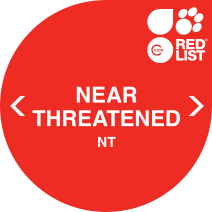
| Red List Category & Criteria: | Near Threatened ver 3.1 | ||||||||||||
| Year Published: | 2012 | ||||||||||||
| Assessor/s: | BirdLife International | ||||||||||||
| Reviewer/s: | Butchart, S. & Symes, A. | ||||||||||||
| Contributor/s: | |||||||||||||
|
Justification: This species exists at naturally low numbers, as a result of its narrow habitat requirements, thus it may have a moderately small population, and is likely to be declining as a result of habitat loss and fragmentation throughout its range. It is therefore listed as Near Threatened. |
|||||||||||||
| History: |
|
||||||||||||
| Range Description: | Alcedo hercules occurs in southern China (rare), eastern Nepal (vagrant), Bhutan (rare), north-east India (rare), Bangladesh (vagrant), Myanmar (scarce to fairly common in the north, west and south), north-west Thailand (very rare visitor), Laos (uncommon to locally common in the north and Annamite mountains, scarce further south) and Vietnam (locally fairly common in west Tonkin and Annam). Given its linear distribution along rivers, and thus restricted Extent of Occurrence, the total population size is possibly moderately small. |
| Countries: |
Native: Bhutan; China; India; Lao People's Democratic Republic; Myanmar; Thailand; Viet NamVagrant: Bangladesh; Nepal |
| Range Map: | Click here to open the map viewer and explore range. |
| Population: | The global population size has not been quantified, although the population in China has been estimated at fewer than 100 breeding pairs (Brazil 2009). |
| Population Trend: |
Decreasing
|
| Habitat and Ecology: | This species is found along streams in evergreen forest and adjacent open country at 200-1,200 m, mainly 400-1,000 m. |
| Systems: | Terrestrial; Freshwater |
| Major Threat(s): | This species is still widespread at low densities within its historical range, although deforestation is reducing and fragmenting its habitat, and human disturbance and river pollution are possibly also threats. |
| Conservation Actions: |
Conservation Actions Underway None are known. Conservation Actions Proposed Conduct repeated surveys throughout its range to clarify its current population status, as well as assess population trends and rates of range contraction. Conduct ecological studies to identify habitat associations and potential threats. Grant protection to areas of suitable habitat. Enforce laws against river pollution where applicable. Strengthen legislation against aquatic pollution throughout the species's range. |
| Citation: | BirdLife International 2012. Alcedo hercules. In: IUCN 2012. IUCN Red List of Threatened Species. Version 2012.2. <www.iucnredlist.org>. Downloaded on 20 June 2013. |
| Disclaimer: | To make use of this information, please check the <Terms of Use>. |
| Feedback: | If you see any errors or have any questions or suggestions on what is shown on this page, please fill in the feedback form so that we can correct or extend the information provided |