


| Kingdom | Phylum | Class | Order | Family |
|---|---|---|---|---|
| ANIMALIA | CHORDATA | AVES | GALLIFORMES | PHASIANIDAE |
| Scientific Name: | Rollulus rouloul | ||||||
| Species Authority: | (Scopoli, 1786) | ||||||
Common Name/s:
|
|||||||
| Red List Category & Criteria: | Near Threatened ver 3.1 | ||||||
| Year Published: | 2012 | ||||||
| Assessor/s: | BirdLife International | ||||||
| Reviewer/s: | Butchart, S. & Symes, A. | ||||||
| Contributor/s: | |||||||
|
Justification: This spectacular and unique partridge is fairly widespread across the Sundaic lowlands, where it is not uncommon; however, logging has been intense throughout the region and it is likely to have undergone a moderately rapid population reduction. It consequently is classified as Near Threatened. |
|||||||
| History: |
|
||||||
| Range Description: | Rollulus rouloul is confined to the Sundaic lowlands, where it is known from south Tenasserim, Myanmar, peninsular Thailand, Sabah, Sarawak and Peninsular Malaysia, Brunei and Kalimantan and Sumatra, Indonesia (BirdLife International 2001). The species remains common in several areas, is able to persist in selectively logged forest and can utilise early-stage regenerating forest, and although it has undoubtedly declined, it is likely to be secure at present. |
| Countries: | Native: Brunei Darussalam; Indonesia; Malaysia; Myanmar; Thailand |
| Range Map: | Click here to open the map viewer and explore range. |
| Population: | The global population size has not been quantified, but the species is described as one of the most commonly seen South-East Asian galliformes (Madge and McGowan 2002). |
| Population Trend: |
Decreasing
|
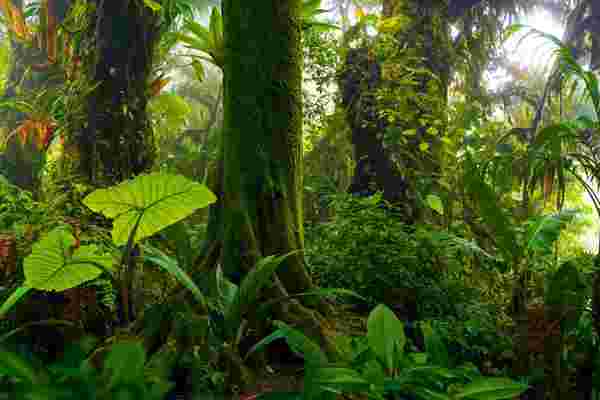
| Habitat and Ecology: | It occurs in broadleaved evergreen and dense primary lowland and hill forests and bamboo up to 1,550 m. |
| Systems: | Terrestrial |
| Major Threat(s): | Forest destruction in the Sundaic lowlands of Indonesia and Malaysia has been extensive (Kalimantan lost nearly 25% of its evergreen forest during 1985-1997, and Sumatra lost almost 30% of its 1985 cover), because of a variety of factors, including the escalation of logging and land conversion, with deliberate targeting of all remaining stands of valuable timber including those inside protected areas, plus forest fires (particularly in 1997-1998), and declines are compounded by trapping for the cage-bird trade. However, the species's use of secondary growth and higher elevations implies that it is not immediately threatened. |
| Conservation Actions: |
Conservation Actions Underway It occurs in a number of protected areas. Conservation Actions Proposed Survey to assess the size of the population. Regularly monitor the population at selected sites. Asses the effect of hunting on populations. Protect large areas of forest in areas where it occurs. |
| Citation: | BirdLife International 2012. Rollulus rouloul. In: IUCN 2012. IUCN Red List of Threatened Species. Version 2012.2. <www.iucnredlist.org>. Downloaded on 22 May 2013. |
| Disclaimer: | To make use of this information, please check the <Terms of Use>. |
| Feedback: | If you see any errors or have any questions or suggestions on what is shown on this page, please fill in the feedback form so that we can correct or extend the information provided |