
Map_thumbnail_large_font

Penelopina nigra

Status_ne_offStatus_dd_offStatus_lc_offStatus_nt_offStatus_vu_onStatus_en_offStatus_cr_offStatus_ew_offStatus_ex_off

Taxonomy [top]

Kingdom Phylum Class Order Family
ANIMALIA CHORDATA AVES GALLIFORMES CRACIDAE

Scientific Name: Penelopina nigra
Species Authority: (Fraser, 1852)
Common Name/s:
English Highland Guan
Spanish Pava Pajuil

Assessment Information [top]

Red List Category & Criteria: Vulnerable A2cd+3cd+4cd ver 3.1
Year Published: 2012
Assessor/s: BirdLife International
Reviewer/s: Butchart, S. & Symes, A.
Contributor/s: Clay, R., Eisermann, K., Hubbell, P., Komar, O., Lubbers, S. & Tanimoto, P.
Justification:
This species's once relatively large population has undergone a rapid decline (owing to habitat loss and degradation, and hunting) which is projected to continue into the future. For this reason it is listed as Vulnerable.

History:
2008 Vulnerable
2007 Vulnerable
2004 Near Threatened

Geographic Range [top]

Range Description: Penelopina nigra inhabits wet premontane and montane broad-leaved forests of subtropical and temperate zones on Pacific and Caribbean slopes of south Mexico (uncommon and local [Eisermann et al. 2006], but moderate numbers in El Triunfo Biosphere Reserve [Gómez de Silva et al. 1999]), Guatemala (still locally common), Honduras, north-central Nicaragua (uncommon and rather local in both) and El Salvador (local [Howell and Webb 1995a, del Hoyo 1994, Vannini and Rockstroh 1997, K. Eisermann in litt. 2007]) . It can occur at densities of 30 birds/km2 and is probably more common than sightings suggest (del Hoyo 1994, Vannini and Rockstroh 1997). Suitable habitat in Guatemala, the apparent global stronghold, has been reduced to under c.10,000 km2, which is less than half its original extent (Vannini and Rockstroh 1997). Since 1990, it has been confirmed from 53 sites throughout its range (Eisermann et al. 2006).

Countries:
Native:
Guatemala; Honduras; Mexico; Nicaragua
Possibly extinct:
El Salvador
Range Map: Click here to open the map viewer and explore range.

Population [top]

Population: A recent extrapolation estimates that all remaining habitat could support a total population of c. 91,000 individuals, although this figure is declining rapidly and this trend is likely to continue (Eisermann et al. 2006).
Population Trend: Decreasing

Habitat and Ecology [top]

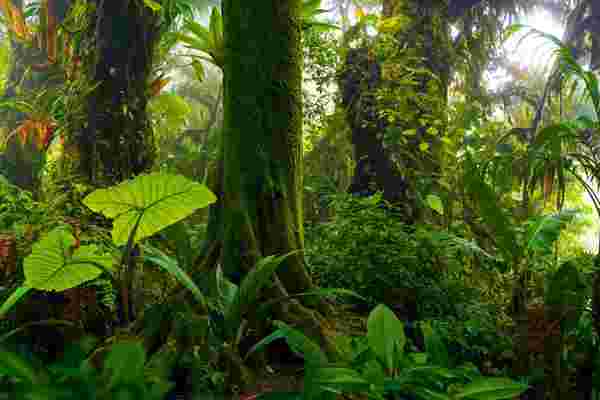
Habitat and Ecology: It inhabits the most humid and densely forested slopes of Chiapas Montane Forest, Chimalapas Montane Forest, Central America Montane Forest and Central America Pine-Oak Forest (Eisermann et al. 2006). Although it is mainly restricted to cloud forest and pine-oak forests, it has also been recorded in mature cypress plantations and low canopy secondary forest (Eisermann et al. 2006). It forages singly, in pairs or small groups, often at twilight, on berries and other fruits from the upper forest canopy to the forest floor (K. Eisermann in litt. 2012).

Systems: Terrestrial

Threats [top]

Major Threat(s): Habitat alteration and hunting pressure are the principal threats. The human population is growing rapidly within the species's range (Eisermann et al. 2006). Forest is cleared for agriculture, particularly coffee plantations and maize fields, but also for plantations of leather leaf ferns (Rumohra adiantiformis) and ponytail (Beaucarnea spp.) (K. Eisermann in litt. 2007), and to a lesser extent for mining (O. Komar in litt. 2007). However, in Guatemala about 50% of the species range are used or planned for exploration and opencast mining (K. Eisermann in litt. 2012). Climate change may threaten the species in the future (O. Komar in litt. 2007), probably through altitudinal shifts in habitat.

Conservation Actions [top]

Conservation Actions: Conservation Actions Underway
At several private reserves in Guatemala, the species's stronghold, habitat is protected and hunting is prevented (Eisermann et al. 2006). In Alta Verapaz, fire-protection zones adjacent to primary cloud forest were established by planting fruit trees, reducing the risk of forest fires from corn plots (K. Eisermann in litt. 2007). Short-term habitat protection is achieved by providing incentives for forest conservation and reforestation (K. Eisermann in litt. 2007). Hunting of the guan is prohibited by law in Mexico, Guatemala and El Salvador (Eisermann et al. 2006, O. Komar in litt. 2007, K. Eisermann in litt. 2012).

Conservation Actions Proposed
Monitor the rates of habitat loss and degradation. Model population trends using data from habitat trends. Carry out research into whether the species is, in part, an altitudinal migrant (Eisermann 2005). Protect remaining forest habitat in existing reserves and by establishing new ones. Encourage local people to exploit sustainable alternative food sources. Promote habitat restoration both within and outside reserves across the species's range (K. Eisermann in litt. 2007). Improve the management of protected areas (K. Eisermann in litt. 2007).

Citation: BirdLife International 2012. Penelopina nigra. In: IUCN 2012. IUCN Red List of Threatened Species. Version 2012.2. <www.iucnredlist.org>. Downloaded on 22 May 2013.
Disclaimer: To make use of this information, please check the <Terms of Use>.
Feedback: If you see any errors or have any questions or suggestions on what is shown on this page, please fill in the feedback form so that we can correct or extend the information provided