



| Kingdom | Phylum | Class | Order | Family |
|---|---|---|---|---|
| ANIMALIA | CHORDATA | AVES | PASSERIFORMES | TYRANNIDAE |
| Scientific Name: | Poecilotriccus luluae | |||
| Species Authority: | Johnson & Jones, 2001 | |||
Common Name/s:
|
||||
| Red List Category & Criteria: | Endangered A3c ver 3.1 | |||||||||||||||
| Year Published: | 2012 | |||||||||||||||
| Assessor/s: | BirdLife International | |||||||||||||||
| Reviewer/s: | Butchart, S. & Symes, A. | |||||||||||||||
| Contributor/s: | Lane, D. & Mark, T. | |||||||||||||||
|
Justification: Based on a model of future deforestation it is suspected that the population of this species will decline very rapidly over the next three generations, and it has therefore been uplisted to Endangered. It also has a small, declining range and population. However, it may in fact benefit from habitat degradation promoting secondary growth, and from abandonment of pasture that is occurring in parts of its range. |
||||||||||||||||
| History: |
|
|||||||||||||||
| Range Description: | Poecilotriccus luluae is known from six localities in north-east Peru: at Wicsocunga, near Lonya Grande, in the northernmost extension of the Cordillera Central (T. Mark in litt. 2003); two sites in the Cordillera de Colán (30 km east of Florida (Johnson and Jones 2001), and south-east of Bagua (Davies et al. (1994)); and three areas to the east in an unnamed range in the Eastern Andes (the García area north-east of Abra Patricia; 6 km south-east of Corosha; and 33 km north-east of Ingenio) (Johnson and Jones 2001; Davies et al. 1994). |
| Countries: | Native: Peru |
| Range Map: | Click here to open the map viewer and explore range. |
| Population: | The population size is preliminarily estimated to fall into the band 2,500-9,999 individuals. This equates to 1,667-6,666 mature individuals, rounded here to 1,500-7,000 mature individuals. |
| Population Trend: |
Decreasing
|
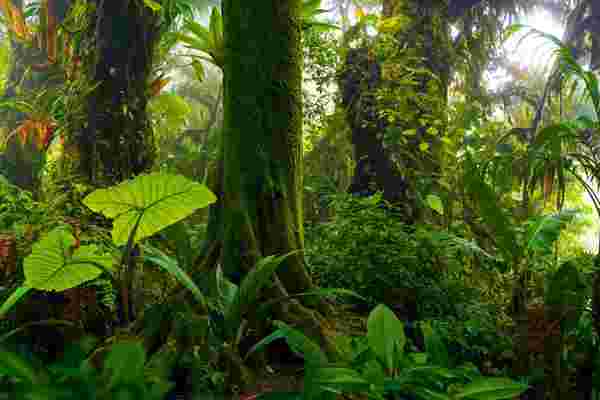
| Habitat and Ecology: | It is found in montane forest at 1,800-2,900 m elevation, usually in or near bamboo thickets but also in shrubby second growth and forest edge (Johnson and Jones 2001; Davis 1986; Hornbuckle 1999b; Schulenberg et al. 2007). It forages almost exclusively through sally-gleans, mostly to the undersurface of live leaves, and is nearly always encountered in pairs (Davis 1986). It has been reported as fairly common to the east of Abra Patricia (Davis 1986; Hornbuckle 1999b). |
| Systems: | Terrestrial |
| Major Threat(s): | The remaining forests within the documented range of the species are being cleared for timber, agriculture and to secure land ownership, particularly rapidly on the Cordillera de Colán (where local people estimated that all remaining forest might be cleared in the ensuing decade). The forest near Abra Patricia is under increased threat since the road was rebuilt in 1998 (Davies et al. 1997). However, the species may benefit from edge habitat created by timber clearing (D. Lane in litt. 2003). |
| Conservation Actions: |
Conservation Actions Underway 1,820 km2 of forest at Abra Patricia and the upper río Mayo, San Martín, is classed as Bosque de Protección del Alto Mayo at the request of local leaders in Rioja, to protect the watershed of the Rio Mayo from logging (Hornbuckle 1999b). Conservation Actions Proposed Establish a protected area containing areas of forest on the Cordillera de Colán. Survey areas of suitable habitat to locate further populations. Determine its ecological requirements, particularly its response to edge habitat creation. |
| Citation: | BirdLife International 2012. Poecilotriccus luluae. In: IUCN 2012. IUCN Red List of Threatened Species. Version 2012.2. <www.iucnredlist.org>. Downloaded on 20 May 2013. |
| Disclaimer: | To make use of this information, please check the <Terms of Use>. |
| Feedback: | If you see any errors or have any questions or suggestions on what is shown on this page, please fill in the feedback form so that we can correct or extend the information provided |