| Kingdom | Phylum | Class | Order | Family |
|---|---|---|---|---|
| ANIMALIA | CHORDATA | AVES | PASSERIFORMES | MOTACILLIDAE |
| Scientific Name: | Motacilla samveasnae | |||
| Species Authority: | Duckworth, Alström, Davidson, Evans, et al., 2001 | |||
Common Name/s:
|
||||
| Taxonomic Notes: | Described as new to science by Duckworth et al. (2001). | |||
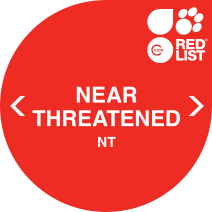
| Red List Category & Criteria: | Near Threatened ver 3.1 | ||||||||||||||||||
| Year Published: | 2012 | ||||||||||||||||||
| Assessor/s: | BirdLife International | ||||||||||||||||||
| Reviewer/s: | Butchart, S. & Symes, A. | ||||||||||||||||||
| Contributor/s: | |||||||||||||||||||
|
Justification: This species has a restricted linear range and a small population. It is highly tolerant of human presence, and its habitat is not particularly vulnerable to human-induced changes. However, the many dams currently proposed for the Mekong, particularly those on sections where the river has a low gradient, have the potential to disrupt long stretches of its riverine range by flooding the river channel. Its small to moderately small population is therefore projected to undergo a moderately rapid decline over the next three generations and it is thus classified as Near Threatened. |
|||||||||||||||||||
| History: |
|
||||||||||||||||||
| Range Description: | Motacilla samveasnae is known, in the breeding season, from a substantial length of the River Mekong and several of its tributaries in Cambodia, extending upstream from Kampi into southern Laos, and there is a record from the non-breeding season in Thailand. The species was first recorded in Vietnam in 2002, where it is likely to be a resident breeder (Le Tron Trai and Craik 2008). In optimal habitat, linear densities may reach many pairs per kilometre, and its numbers are certainly healthy in Cambodia. |
| Countries: | Native: Cambodia; Lao People's Democratic Republic; Thailand; Viet Nam |
| Range Map: | Click here to open the map viewer and explore range. |
| Population: | A preliminary population estimate of 10,000-19,999 individuals assumes that the species's population is moderately small owing to its highly specialised habitat requirements and restricted distribution. This estimate equates to 6,667-13,333 mature individuals, rounded here to 6,000-15,000 mature individuals. |
| Population Trend: |
Decreasing
|
| Habitat and Ecology: | It breeds in riverine "channel mosaic" habitat, typically in broad, lowland rivers, where the streambed is exposed to provide rocky outcrops and bushland, gravel shoals and/or sandbars, tufted grasses and annual dicotyledons. It avoids wooded areas. It will regularly feed within bushes in the water, walking along branches and picking food items from these and from leaves. |
| Systems: | Terrestrial; Freshwater |
| Major Threat(s): | It is highly tolerant of human presence, and its habitat is not particularly vulnerable to human-induced changes. However, the many dams currently proposed for the Mekong, particularly those on sections where the river has a low gradient, have the potential to disrupt long stretches of its riverine range by flooding the river channel. |
| Conservation Actions: |
Conservation Actions Underway Short sections of its habitat occur in several protected areas, but this is unlikely to afford much protection from dam development. Active conservation for this and other riverine wetland species will centre on holistic review and modification of proposals for large dams, and will necessitate international cooperation. Conservation Actions Proposed Carry out surveys to assess the total population size. Monitor population trends through regular surveys. Encourage the completion of environmental impact assessments prior to dam construction along the Mekong River channel and ensure that recommendations are acted upon. Mitigate against any likely habitat loss that may result from dam construction. |
| Citation: | BirdLife International 2012. Motacilla samveasnae. In: IUCN 2012. IUCN Red List of Threatened Species. Version 2012.2. <www.iucnredlist.org>. Downloaded on 18 May 2013. |
| Disclaimer: | To make use of this information, please check the <Terms of Use>. |
| Feedback: | If you see any errors or have any questions or suggestions on what is shown on this page, please fill in the feedback form so that we can correct or extend the information provided |