

Map_thumbnail_large_font

Chlorochrysa nitidissima

Status_ne_offStatus_dd_offStatus_lc_offStatus_nt_offStatus_vu_onStatus_en_offStatus_cr_offStatus_ew_offStatus_ex_off

Taxonomy [top]

Kingdom Phylum Class Order Family
ANIMALIA CHORDATA AVES PASSERIFORMES THRAUPIDAE

Scientific Name: Chlorochrysa nitidissima
Species Authority: Sclater, 1873
Common Name/s:
English Multicolored Tanager, Multicoloured Tanager

Assessment Information [top]

Red List Category & Criteria: Vulnerable B1ab(i,ii,iii,v) ver 3.1
Year Published: 2012
Assessor/s: BirdLife International
Reviewer/s: Butchart, S. & Symes, A.
Contributor/s: Cuervo, A., Dávalos, L., Donegan, T. & Salaman, P.
Justification:
This species has a small range, and is known from a small number of locations. Its known population is suspected to be small, fragmented into very small subpopulations, and declining as a result of continuing habitat loss. Consequently, it is listed as Vulnerable.

History:
2008 Vulnerable
2004 Vulnerable
2000 Vulnerable
1996 Vulnerable
1994 Vulnerable

Geographic Range [top]

Range Description: Chlorochrysa nitidissima occurs in the west and north-central Andes of Colombia (in Antioquia, Caldas, Risaralda, Quindío, Valle del Cauca and Cauca). There are records from only two sites in the central Andes since 1951: Ucumarí Regional Park, Risaralda, in the early 1990s (Wege and Long 1995), and the northernmost locality near Anorí, Antioquia, in 1999 (A. Cuervo in litt. 1999). The great majority of modern records in the west Andes are from accessible sites in Valle del Cauca. It was formerly common, but is now infrequently recorded, although it remains fairly common locally, even in remnant forest fragments.

Countries:
Native:
Colombia
Range Map: Click here to open the map viewer and explore range.

Population [top]

Population: Extrapolating recorded densities across the species's range (assuming 10% of its Extent of Occurrence is likely to be occupied) gives a preliminary population estimate of 21,970 individuals. As this is a rough estimate, it is best placed in the band 20,000-49,999 individuals. A more accurate population estimate is desirable.
Population Trend: Decreasing

Habitat and Ecology [top]

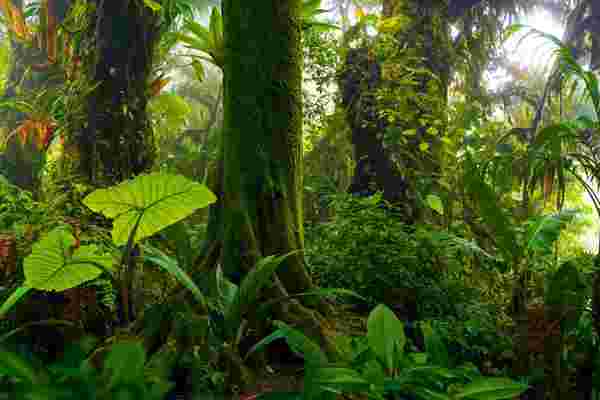
Habitat and Ecology: It inhabits humid, mossy, montane forest and borders in the subtropical zone at 1,300-2,200 m, exceptionally as low as 1,140 m in the central Andes, and 900 m in the West Andes. In adjacent areas, it also occurs regularly in mature secondary forest and clearings with a few large trees left standing. The diet comprises insects, mainly taken when foraging with mixed-species flocks, and fruit.

Systems: Terrestrial

Threats [top]

Major Threat(s): Deforestation has been severe in many parts of its range, notably Valle del Cauca, Cerro Tatamá, along the Buenaventura-Cali and Buenaventura-Buga roads, and around Medellín (Wege and Long 1995, Salaman and Stiles 1996). However, large blocks of primary forest remain, e.g. in Farallones de Cali and Los Nevados national parks, and on the Caramanta Massif (Wege and Long 1995, Stiles 1998). The rapid expansion of the road network is opening up more remote parts of the species's range to logging, mining and human settlement (Salaman and Stiles 1996). Immigration will inevitably lead to deforestation (Stiles 1998), through small-scale agriculture and subsistence activities.

Conservation Actions [top]

Conservation Actions: Conservation Actions Underway
It has been recently recorded in the Ucumarí section of Los Nevados National Park, Yotoco Forest Reserve, Farallones de Cali National Park, Tambito Nature Reserve and Munchique National Park (Wege and Long 1995, P. G. W. Salaman in litt. 1999). The northernmost site is within a proposed regional park (A. Cuervo in litt. 1999). Education and awareness activities within the western Andes have included local schools participating in a Bird Month Celebration and publication of a conservation magazine (Fierro-Calderón et al. 2009).

Conservation Actions Proposed
Survey poorly-known areas of habitat, e.g. in Farallones de Cali National Park (L. Dávalos in litt. 1999). Enforce conservation measures in protected areas, specifically in providing non-damaging alternatives to settlers in Munchique National Park and the Tambito region (L. Dávalos in litt. 1999, P. G. W. Salaman in litt. 1999, T. Donegan in litt. 2012). Research its ecological requirements and population size (Renjifo et al. 2002). Use recent information to produce a regional management plan for the western Andes (Fierro-Calderón et al. 2009).

Citation: BirdLife International 2012. Chlorochrysa nitidissima. In: IUCN 2012. IUCN Red List of Threatened Species. Version 2012.2. <www.iucnredlist.org>. Downloaded on 22 May 2013.
Disclaimer: To make use of this information, please check the <Terms of Use>.
Feedback: If you see any errors or have any questions or suggestions on what is shown on this page, please fill in the feedback form so that we can correct or extend the information provided