| Kingdom | Phylum | Class | Order | Family |
|---|---|---|---|---|
| ANIMALIA | CHORDATA | AVES | PASSERIFORMES | TIMALIIDAE |
| Scientific Name: | Alcippe variegaticeps | |||
| Species Authority: | Yen, 1932 | |||
Common Name/s:
|
||||
| Red List Category & Criteria: | Vulnerable B1ab(ii,iii,iv,v);C2a(i) ver 3.1 | |||||||||||||||
| Year Published: | 2012 | |||||||||||||||
| Assessor/s: | BirdLife International | |||||||||||||||
| Reviewer/s: | Butchart, S. & Symes, A. | |||||||||||||||
| Contributor/s: | Dowell, S. & Fellowes, J. | |||||||||||||||
|
Justification: This species has a small and severely fragmented range, and is suspected to be in population decline as a result of forest clearance through logging and conversion to agriculture. It therefore qualifies as Vulnerable |
||||||||||||||||
| History: |
|
|||||||||||||||
| Range Description: | Alcippe variegaticeps is endemic to China, where it is known from south-central Sichuan and the mountains of northern Guangxi, although it presumably occurs in some of the intervening areas (BirdLife International 2001). Its population is inferred to be small and declining given the limited area of suitable habitat and the threats to it. |
| Countries: | Native: China |
| Range Map: | Click here to open the map viewer and explore range. |
| Population: | The population is estimated to number 2,500-9,999 mature individuals based on an assessment of known records, descriptions of abundance and range size. This is consistent with recorded population density estimates for congeners or close relatives with a similar body size, and the fact that only a proportion of the estimated Extent of Occurrence is likely to be occupied. This estimate is equivalent to 3,750-14,999 individuals in total, rounded here to 3,500-15,000 individuals. |
| Population Trend: |
Decreasing
|
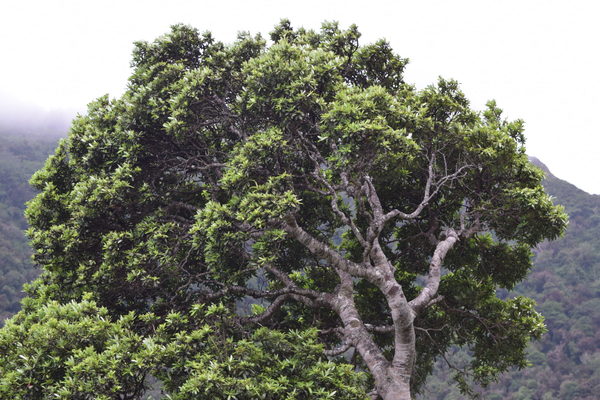
| Habitat and Ecology: | It inhabits subtropical and montane broadleaved forest, usually with extensive shrub and bamboo undergrowth, often in small stream valleys, at c.700-2,000 m. It feeds on insects and spiders, and forages on mossy branches. |
| Systems: | Terrestrial; Freshwater |
| Major Threat(s): | The main threat is the loss and fragmentation of forest within its range, much of which has already been cleared or degraded through logging, conversion to agriculture and, in Guangxi, uncontrolled fire. Remaining forest is under intense pressure: until recently, almost all primary broadleaved forests in southern Sichuan had been scheduled for logging in the next 20-25 years, although there has been a recent ban on large-scale logging in Sichuan, in the western part of this species's range. Collection of bamboo shoots and grazing of livestock in forests causes disturbance during the breeding season. Climate change could pose a threat to the suitability of montane refuges in future (J. Fellowes in litt. 2007). |
| Conservation Actions: |
Conservation Actions Underway It has been recorded from several protected areas including Mabian Dafengding Nature Reserve, Labahe Nature Reserve, Emei Shan Protected Scenic Site (Sichuan), Laojunshan Nature Reserve, Mamize Nature Reserve and Dayao Shan Nature Reserve (Guangxi). Emei Shan is protected as a sacred mountain. Most records from the Sichuan part of its range, however, are in forest areas that are currently unprotected (e.g. in forests near Xining in Leibo county) (S. Dowell in litt. 2007). Some forestry practices, notably leaving strips of primary forest along ridge-tops and replanting with native broadleaved trees, may be beneficial. Survey work has improved knowledge of its distribution, population and ecological and conservation requirements. Laojunshan and Mamize Nature Reserves have received support to train and equip staff and to encourage alternative livelihoods and sustainable management practices amongst local communities from the Sichuan Forest Biodiversity Project (a collaboration between the Sichuan Forest Department, Chester Zoo and Liverpool John Moores University). Conservation Actions Proposed Survey known sites and other areas of suitable habitat, including gaps in the current known range in Guizhou and north Guangxi, to determine population size and trends. Conduct surveys and ecological research with the aim of producing management recommendations for forests where it occurs. Gazette new protected areas where appropriate. Support recommendations to establish a network of protected areas for Sichuan Partridge Arborophila rufipectus, including areas in the north of Leibo county, as this will also protect habitat for this species. At Labahe Nature Reserve, reconstruct forest corridors to the Qionglai Shan Conservation Unit. Jointly manage Mabian Dafengding Nature Reserve with Meigu Dafengding Reserve. Gazette the Emei Shan Protected Scenic Site as a nature reserve, control tourism and strengthen research work. Control logging and the planting of star anis at Dayao Shan Nature Reserve. Maintain strips of primary forest along ridge-tops, continue replanting with native broadleaved trees, and increase linkage between isolated montane sites. |
| Citation: | BirdLife International 2012. Alcippe variegaticeps. In: IUCN 2012. IUCN Red List of Threatened Species. Version 2012.2. <www.iucnredlist.org>. Downloaded on 23 May 2013. |
| Disclaimer: | To make use of this information, please check the <Terms of Use>. |
| Feedback: | If you see any errors or have any questions or suggestions on what is shown on this page, please fill in the feedback form so that we can correct or extend the information provided |