
Map_thumbnail_large_font

Chloropsis cyanopogon

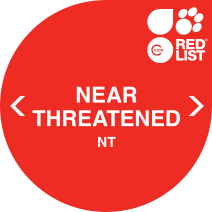
Status_ne_offStatus_dd_offStatus_lc_offStatus_nt_onStatus_vu_offStatus_en_offStatus_cr_offStatus_ew_offStatus_ex_off

Taxonomy [top]

Kingdom Phylum Class Order Family
ANIMALIA CHORDATA AVES PASSERIFORMES CHLOROPSEIDAE

Scientific Name: Chloropsis cyanopogon
Species Authority: (Temminck, 1829)
Common Name/s:
English Lesser Green Leafbird

Assessment Information [top]

Red List Category & Criteria: Near Threatened ver 3.1
Year Published: 2012
Assessor/s: BirdLife International
Reviewer/s: Butchart, S. & Symes, A.
Contributor/s:
Justification:
This forest-associated species is listed as Near Threatened because it is assumed to have experienced moderately rapid declines owing to the extensive loss of lowland forests from large areas of South-East Asia. It is not considered more threatened because it can use secondary and edge habitats (BirdLife International 2001, Wells 2005).

History:
2008 Near Threatened
2004 Near Threatened

Geographic Range [top]

Range Description: Chloropsis cyanopogon is restricted to the Sundaic lowlands, from south Tenasserim, Myanmar, peninsular Thailand, Singapore (scarce), Sabah, Sarawak and Peninsular Malaysia, Kalimantan (including Banggi Island) and Sumatra, Indonesia and Brunei, where it is generally fairly common in forest to 700 m.

Countries:
Native:
Brunei Darussalam; Indonesia; Malaysia; Myanmar; Singapore; Thailand
Range Map: Click here to open the map viewer and explore range.

Population [top]

Population: The population size is unknown, but the species is described as common where habitat remains (del Hoyo et al. 2006).
Population Trend: Decreasing

Habitat and Ecology [top]

Habitat and Ecology: Canopy and high edge of lowland evergreen forest, including peat-swamp forest, mature and regenerating secondary forest, also fruiting trees and shrubs in clearings and high shade cover of plantations. It occurs up to 700 m in most of its range but occasionally to 1,100 m in Malaysia. Birds in breeding condition have been recorded in February-August.

Systems: Terrestrial

Threats [top]

Major Threat(s): Forest destruction in the Sundaic lowlands of Indonesia, and in Thailand and Malaysia has been extensive (Kalimantan lost nearly 25% of its evergreen forest during 1985-1997, and Sumatra lost almost 30% of its 1985 cover), but the species's ability to survive in second growth and forest edge implies that it is not immediately threatened.

Conservation Actions [top]

Conservation Actions: Conservation Actions Underway
None are known.

Conservation Actions Proposed
Protect areas of lowland forest within the species's range. Enforce restrictions on agricultural encroachment and logging within such protected areas. Estimate population trends by calculating rates of forest loss within its range using satellite imagery and remote sensing techniques.

Citation: BirdLife International 2012. Chloropsis cyanopogon. In: IUCN 2012. IUCN Red List of Threatened Species. Version 2012.2. <www.iucnredlist.org>. Downloaded on 23 May 2013.
Disclaimer: To make use of this information, please check the <Terms of Use>.
Feedback: If you see any errors or have any questions or suggestions on what is shown on this page, please fill in the feedback form so that we can correct or extend the information provided