| Kingdom | Phylum | Class | Order | Family |
|---|---|---|---|---|
| ANIMALIA | CHORDATA | AVES | PASSERIFORMES | ACANTHISITTIDAE |
| Scientific Name: | Traversia lyalli | |||
| Species Authority: | (Rothschild, 1894) | |||
Common Name/s:
|
||||
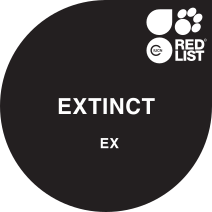
| Red List Category & Criteria: | Extinct ver 3.1 | |||||||||||||||
| Year Published: | 2012 | |||||||||||||||
| Assessor/s: | BirdLife International | |||||||||||||||
| Reviewer/s: | Butchart, S. & Symes, A. | |||||||||||||||
| Contributor/s: | ||||||||||||||||
|
Justification: This species is known from Stephens Island, New Zealand, but became Extinct in 1895. A combination of development on the island and predation by introduced cats is thought to have driven its decline. |
||||||||||||||||
| History: |
|
|||||||||||||||
| Range Description: | Traversia lyalli is only known from recent times from Stephens Island, New Zealand (Greenway 1967), although it is common in fossil deposits from both of the main islands (Worthy and Holdaway 1994). It was extinct by November 1895, but it had survived into that year, with Travers finding a cat-caught specimen in February (Tennyson and Martinson 2006). |
| Countries: | Regionally extinct: New Zealand |
| Range Map: | Click here to open the map viewer and explore range. |
| Habitat and Ecology: | The species was flightless and restricted to the rocky ground (Millener 1989). |
| Systems: | Terrestrial |
| Major Threat(s): | Construction of a lighthouse on Stephens Island in 1894 led to the clearance of most of the island's forest, with predation by the lighthouse keeper's cat delivering the species's coup-de-grace (Tyrberg & Milberg 1991). |
| Citation: | BirdLife International 2012. Traversia lyalli. In: IUCN 2012. IUCN Red List of Threatened Species. Version 2012.2. <www.iucnredlist.org>. Downloaded on 25 May 2013. |
| Disclaimer: | To make use of this information, please check the <Terms of Use>. |
| Feedback: | If you see any errors or have any questions or suggestions on what is shown on this page, please fill in the feedback form so that we can correct or extend the information provided |