Map_thumbnail_large_font

Charadrius obscurus

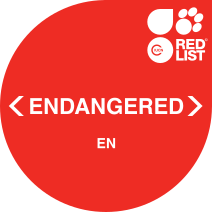
Status_ne_offStatus_dd_offStatus_lc_offStatus_nt_offStatus_vu_offStatus_en_onStatus_cr_offStatus_ew_offStatus_ex_off

Taxonomy [top]

Kingdom Phylum Class Order Family
ANIMALIA CHORDATA AVES CHARADRIIFORMES CHARADRIIDAE

Scientific Name: Charadrius obscurus
Species Authority: Gmelin, 1789
Common Name/s:
English New Zealand Dotterel, New Zealand Plover, Red-breasted Plover

Assessment Information [top]

Red List Category & Criteria: Endangered C2a(i) ver 3.1
Year Published: 2012
Assessor/s: BirdLife International
Reviewer/s: Butchart, S. & Symes, A.
Contributor/s: Dowding, J., Hitchmough, R. & Parrish, R.
Justification:
This species has a very small, severely fragmented population and a small overall range. Extirpation of the southern subspecies has been averted owing to extensive predator control, and numbers are now gradually increasing. However, the status of the northern subspecies is uncertain and populations in some areas have undergone substantial declines. The species is therefore listed as Endangered. Further clarification of the status of the northern subspecies may lead to downlisting in the future.

History:
2008 Endangered
2006 Endangered
2005 Endangered
2004 Vulnerable
2000 Vulnerable
1996 Endangered
1994 Endangered

Geographic Range [top]

Range Description: Charadrius obscurus is endemic to New Zealand. Subspecies obscurus is now restricted when breeding to Stewart Island, but formerly occurred on the South Island (Dowding 1999). On Stewart Island, it declined by as much as 80% in c.40 years, numbering 62 birds (including only 18 pairs) in 1991-1992 (Dowding and Murphy 1993), but thanks to the poisoning of feral cats it recovered to 111 birds in 1997, 150 in 1999 and 250 in 2005 (J. E. Dowding in litt. 1999, Wilson 2005, Dowding 2006). Subspecies aquilonius breeds in northern North Island. The population was estimated at 1,313 birds in 1989, 1,452 in 1996 and 1,701 in 2004. The current population status is management-dependent, and significant declines would begin immediately if intensive management stopped (R. Hitchmough in litt. 2005). Management at some sites is funded by programmes for other species, and there is no guarantee that the current level of management will continue. The east coast of the North Island holds 83% of the northern subspecies's population including all managed subpopulations. It has been declining rapidly at Wiakato and elsewhere along the west coast and local extinction and a consequent reduction in its range size are likely.

Countries:
Native:
New Zealand
Range Map: Click here to open the map viewer and explore range.

Population [top]

Population: The latest estimate for subspecies aquilonius was that its population numbered 1,701 in October 2004. The latest for subspecies obscurus was that its population numbered 270, in April 2006 (J. E. Dowding in litt. 2008). This totals c.2,000 individuals, equating to c.1,300 mature individuals. Within the northern subspecies, if subpopulations are found to contribute to larger metapopulations (in excess of 250 individuals) with gene flow between them, then the species will warrant downlisting.
Population Trend: Increasing

Habitat and Ecology [top]

Habitat and Ecology: On the North Island, it usually breeds on wide ocean beaches, estuaries and harbours with tidal mudflats (Heather and Robertson 1997). On Stewart Island, it breeds inland, usually at high altitudes on bare hilltops and open bog or tussock-grasslands (J. E. Dowding in litt. 1999). It lays three eggs. It feeds mostly on terrestrial and aquatic invertebrates. Young generally begin to breed in their second year. The oldest recorded bird lived to at least 31 years of age (Heather and Robertson 1997).

Systems: Terrestrial; Freshwater; Marine

Threats [top]

Major Threat(s): Introduced predators were the primary cause of extinction on the South Island (Dowding 1999). They remain the greatest threat on the North Island - one study indicated that at unmanaged sites 60% of nests were lost to predators (Dowding 1998). Feral cats caused the rapid decline on Stewart Island (Dowding and Murphy 1993). On the North Island, housing developments and encroachment by dune-stabilising weeds reduce habitat, and disturbance by livestock, humans, dogs and vehicles reduces breeding success (Dowding 1993, Lord et al. 2001). A known breeding site has been bulldozed as part of an attempted storm protection programme (Anon. 2008). Storms and very high tides can cause nest failures (J. E. Dowding in litt. 1999, Wills et al. 2003). Where native avian predators (notably Kelp Gull Larus dominicanus) occur at high densities, they are a significant threat to eggs and chicks.

Conservation Actions [top]

Conservation Actions: Conservation Actions Underway
On the North Island, management at important breeding sites includes predator trapping, gull control, advocacy, reduction of nest losses to flooding, and the presence of wardens (Dowding and Davis 2007). This results in local improvements in breeding success - 20% of c.600 breeding pairs were managed in 1998-1999 (Dowding and Murphy 2001). In some areas, there is substantial community involvement in management (Dowding 2006). On Stewart Island, cats and rodents are intensively controlled at four important breeding sites (J. E. Dowding in litt. 1999, Ombler 2006). Captive-breeding trials with aquilonius have been undertaken in case the technique is required for obscurus (Dowding 1998). Chicks have been raised successfully (J. E. Dowding in litt. 1999), but their survival in the wild has been low. A revised species recovery plan was published in 2007 (Dowding and Davis 2007).

Conservation Actions Proposed
Complete a full North Island census every seven years. Continue existing protection programmes on North Island. Expand protection to new sites on North Island, with priorities being on the west coast and in the Far North. Increase community involvement and other-agency partnerships in management activities on North Island. Identify and protect important breeding, roosting and flocking habitat on North Island by advocacy and statutory protection. Estimate the population size annually on Stewart Island. Continue current management on Stewart Island. Maintain the mustelid-free status of Stewart Island. Investigate more cost-effective methods of cat control on Stewart Island.

Citation: BirdLife International 2012. Charadrius obscurus. In: IUCN 2012. IUCN Red List of Threatened Species. Version 2012.2. <www.iucnredlist.org>. Downloaded on 19 May 2013.
Disclaimer: To make use of this information, please check the <Terms of Use>.
Feedback: If you see any errors or have any questions or suggestions on what is shown on this page, please fill in the feedback form so that we can correct or extend the information provided