


| Kingdom | Phylum | Class | Order | Family |
|---|---|---|---|---|
| ANIMALIA | CHORDATA | AVES | GRUIFORMES | MESITORNITHIDAE |
| Scientific Name: | Mesitornis unicolor | ||||||
| Species Authority: | (Des Murs, 1845) | ||||||
Common Name/s:
|
|||||||
| Red List Category & Criteria: | Vulnerable A2cde+3cde+4cde;C2a(i) ver 3.1 | |||||||||||||||
| Year Published: | 2012 | |||||||||||||||
| Assessor/s: | BirdLife International | |||||||||||||||
| Reviewer/s: | Butchart, S. & Taylor, J. | |||||||||||||||
| Contributor/s: | Hawkins, F. | |||||||||||||||
|
Justification: This species is listed as Vulnerable because its habitat is becoming increasingly fragmented, its extent of occurrence and the area and quality of suitable habitat are decreasing, and thus its small population is suspected to be declining rapidly. |
||||||||||||||||
| History: |
|
|||||||||||||||
| Range Description: | Mesitornis unicolor has a patchy distribution in the eastern rainforest of Madagascar (Morris and Hawkins 1998), known for certain from as far north as Marojejy and the Masoala peninsula and extending almost as far south as Taolañaro (Fort Dauphin). It is thinly distributed and never common, although its status is difficult to ascertain as it is secretive and rarely seen. |
| Countries: | Native: Madagascar |
| Range Map: | Click here to open the map viewer and explore range. |
| Population: | The population is estimated to number 2,500-9,999 mature individuals based on an assessment of known records, descriptions of abundance and range size. This is consistent with recorded population density estimates for congeners or close relatives with a similar body size, and the fact that only a proportion of the estimated Extent of Occurrence is likely to be occupied. This estimate is equivalent to 3,750-14,999 individuals, rounded here to 3,500-15,000 individuals. |
| Population Trend: |
Decreasing
|
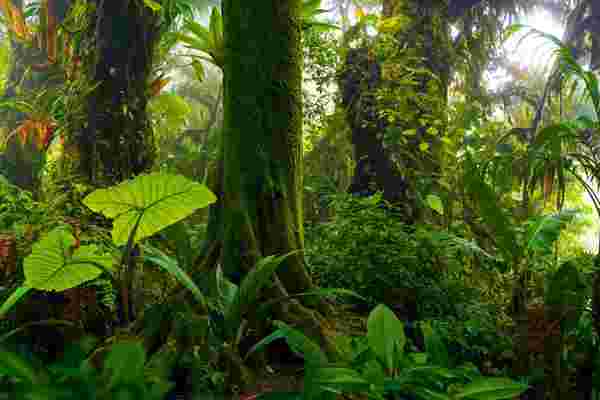
| Habitat and Ecology: | This is a ground-dwelling species of undisturbed primary, evergreen, humid forest (Langrand 1990; Morris and Hawkins 1998). It occurs from sea-level to 1,200 m but is most frequently encountered below 800 m. It seems to prefer steep slopes and dark areas with much leaf-litter and little herbaceous growth (Langrand 1990; Morris and Hawkins 1998). It forages on the forest floor for seeds and small insects, often in family groups of two to three (Langrand 1990), also gleaning from leaves and stems at ground-level (Evans et al. 1992). The nest is built 1-1.5 m from the ground and clutch-size is one. |
| Systems: | Terrestrial |
| Major Threat(s): | Rainforest is under pressure from slash-and-burn cultivation by subsistence farmers, with commercial timber exploitation and hunting in some areas (Morris and Hawkins 1998; ZICOMA 1999). Near villages, dogs and rats Rattus may predate the species as it is a reluctant flier (Langrand 1990). |
| Conservation Actions: |
Conservation Actions Underway The species is known from 14 Important Bird Areas in eastern Madagascar, including seven National Parks, one Strict Reserve, four Special Reserves and one Classified Forest (ZICOMA 1999). Conservation Actions Proposed Monitor rainforest clearance and degradation. Assess threat posed by predatory non-native mammals. Conduct interviews to assess the level of mortality from hunting. Protect remaining tracts of rainforest on the east coast through community reserves and carbon trading. |
| Citation: | BirdLife International 2012. Mesitornis unicolor. In: IUCN 2012. IUCN Red List of Threatened Species. Version 2012.2. <www.iucnredlist.org>. Downloaded on 18 May 2013. |
| Disclaimer: | To make use of this information, please check the <Terms of Use>. |
| Feedback: | If you see any errors or have any questions or suggestions on what is shown on this page, please fill in the feedback form so that we can correct or extend the information provided |