


| Kingdom | Phylum | Class | Order | Family |
|---|---|---|---|---|
| ANIMALIA | CHORDATA | AVES | PSITTACIFORMES | PSITTACIDAE |
| Scientific Name: | Psittinus cyanurus | ||||||
| Species Authority: | (Forster, 1795) | ||||||
Common Name/s:
|
|||||||
| Red List Category & Criteria: | Near Threatened ver 3.1 | ||||||
| Year Published: | 2012 | ||||||
| Assessor/s: | BirdLife International | ||||||
| Reviewer/s: | Butchart, S. & Symes, A. | ||||||
| Contributor/s: | |||||||
|
Justification: This forest-associated species is listed as Near Threatened because it is assumed to have experienced moderately rapid declines owing to the extensive loss of lowland forests from large areas of the Sundaic lowlands, and it may be impacted by trade. It is not considered more threatened because it can use secondary habitats and also occurs in (less threatened) lower montane forest. |
|||||||
| History: |
|
||||||
| Range Description: | Psittinus cyanurus is confined to the Sundaic lowlands, where it is known from south Tenasserim, Myanmar, peninsular Thailand, Sabah, Sarawak and Peninsular Malaysia, Singapore, Kalimantan, Sumatra (including the Riau, Lingga, Bangka, Simeulue, Mentawai islands), Indonesia and Brunei (Juniper and Parr 1998, BirdLife International 2001). It is only locally common and generally rarer than sympatric Psittacula species. Nevertheless, the global population is thought to be in excess of 100,000 individuals, but declining. |
| Countries: | Native: Brunei Darussalam; Indonesia; Malaysia; Myanmar; Singapore; Thailand |
| Range Map: | Click here to open the map viewer and explore range. |
| Population: | The global population size has not been quantified, but the species is described as common in primary habitat and uncommon in secondary habitats and plantations (del Hoyo et al. 1997). |
| Population Trend: |
Decreasing
|
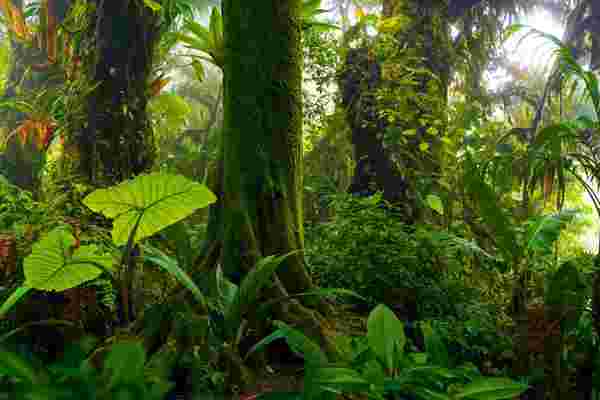
| Habitat and Ecology: | It inhabits primary, dry-land evergreen and semi-evergreen lowland forest, both mature and selectively logged, and also visits edge vegetation, cultivated areas and gap-phase growth of forest clearings and occasionally mangroves, up to 1,300 m, although generally below 700 m. It is gregarious and regularly forms flocks of up to 20 individuals. Breeding occurs in February to May in Malaysia, and June to September in Borneo. |
| Systems: | Terrestrial |
| Major Threat(s): | Forest destruction in the Sundaic lowlands of Indonesia and Malaysia has been extensive (Kalimantan lost nearly 25% of its evergreen forest during 1985-1997, and Sumatra lost almost 30% of its 1985 cover), because of a variety of factors, including the escalation of logging and land conversion, with deliberate targeting of all remaining stands of valuable timber including those inside protected areas, plus forest fires (particularly in 1997-1998), and declines are compounded by trapping for the cage-bird industry. However, the species's use of secondary growth and higher elevations implies that it is not immediately threatened. |
| Conservation Actions: |
Conservation Actions Underway CITES Appendix II. Conservation Actions Proposed Monitor the species's occurrence in trade and address this threat if necessary. Calculate rates of forest loss in the Sundaic lowlands using satellite imagery and remote sensing techniques and estimate population trends accordingly. Protect remaining areas of lowland forest within its range. |
| Citation: | BirdLife International 2012. Psittinus cyanurus. In: IUCN 2012. IUCN Red List of Threatened Species. Version 2012.2. <www.iucnredlist.org>. Downloaded on 21 May 2013. |
| Disclaimer: | To make use of this information, please check the <Terms of Use>. |
| Feedback: | If you see any errors or have any questions or suggestions on what is shown on this page, please fill in the feedback form so that we can correct or extend the information provided |