


| Kingdom | Phylum | Class | Order | Family |
|---|---|---|---|---|
| ANIMALIA | CHORDATA | AVES | CORACIIFORMES | MOMOTIDAE |
| Scientific Name: | Electron carinatum | |||
| Species Authority: | (Du Bus & Gisignies, 1847) | |||
Common Name/s:
|
||||
| Red List Category & Criteria: | Vulnerable C2a(i) ver 3.1 | |||||||||
| Year Published: | 2012 | |||||||||
| Assessor/s: | BirdLife International | |||||||||
| Reviewer/s: | Butchart, S. & Symes, A. | |||||||||
| Contributor/s: | Biamonte, E., Bonta, M., Criado, J., Eisermann, K., Gómez de Silva, H., Miller, B., Miller, C., Sánchez, C., Sánchez, J., Sandoval, L., Stiles, F. & Zook, J. | |||||||||
|
Justification: This species has a relatively large and fragmented range, but it occurs at low densities and therefore requires large expanses of undisturbed habitat to sustain viable populations (Collar et al. 1992). It is classified as Vulnerable because its small population occurs in one of the most threatened habitats in Central America, and is consequently suspected to be in decline. |
||||||||||
| History: |
|
|||||||||
| Range Description: | Electron carinatum has been recorded at a relatively small number of localities scattered over an extensive range in Central America, generally on the Caribbean slope of south Mexico, south Belize, Guatemala, north and central Honduras, north-central Nicaragua, and north-central Costa Rica (Miller and Miller 1996, AOU 1998, M. Bonta in litt. 1999). Records of two individuals from La Tirimbina, Costa Rica, in February 2004 may be the southernmost for this species (R. Garrigues in litt. 2007). Most records have been of pairs or single birds, and it has been recorded only once at most localities. The exceptions to this are recent observations in Belize, Guatemala, Honduras and Costa Rica but, even at these sites, it occurs at a very low density and is generally considered rare to uncommon (Miller and Miller 1996, Eisermann 2005, J. E. Sanchez et al. in litt. 2007). In Belize, records are concentrated in the southern Greater Maya Mountain region of the country (B.W. and C. M. Miller in litt. 2007), and most populations are small and many are significantly isolated (Miller and Miller 1996). In Costa Rica, there have been several recent records, mostly in Volcán Arenal area, from private reserves and the national park (J. E. Sanchez et al. in litt. 2007, R. Garrigues in litt. 2007). It appears to have declined in range in Mexico and parts of Guatemala, and there are very few recent records in Mexico (Gómez de Silva 2002, H. Gómez de Silva in litt. 2007). Mixed pairs of E. carinatum and Broad-billed Motmot Electron platyrhynchum have been documented in Costa Rica (J. E. Sanchez et al. in litt. 2007, R. Garrigues in litt. 2007) with records at three different sites in the Arenal area (R. Garrigues in litt. 2007). |
| Countries: | Native: Belize; Costa Rica; Guatemala; Honduras; Mexico; Nicaragua |
| Range Map: | Click here to open the map viewer and explore range. |
| Population: | The population is estimated to number 2,500-9,999 individuals based on an assessment of known records, descriptions of abundance and range size. This is consistent with recorded population density estimates for congeners or close relatives with a similar body size, and the fact that only a proportion of the estimated Extent of Occurrence is likely to be occupied. This estimate is equivalent to 1,667-6,666 mature individuals, rounded here to 1,500-7,000 mature individuals. |
| Population Trend: |
Decreasing
|
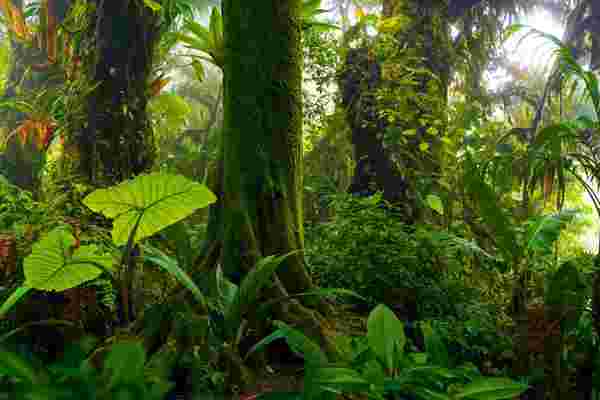
| Habitat and Ecology: | It occurs in humid lowland and montane forest up to 760 m, but there are three records at 1,220-1,555 m in Honduras (Miller and Miller 1996). In Costa Rica, it is restricted to foothill and adjacent lowland primary and old secondary forests (F. G. Stiles in litt. 1999, J. E. Sanchez et al. in litt. 2007). In Belize, it has been recorded most densely in an area of steep terrain intersected by many seasonal streams (Miller and Miller 1996). Nests in Costa Rica have been found in road and trail banks (J. E. Sanchez et al. in litt. 2007). |
| Systems: | Terrestrial; Freshwater |
| Major Threat(s): | In Mexico, all suitable habitat is being cleared at an alarming rate, and in Costa Rica the foothills have been heavily deforested since 1980 (F. G. Stiles in litt. 1999). Most habitat loss is the result of human settlement and conversion to subsistence agriculture, especially banana plantations. In Costa Rica, most of the habitat lost has been cut during logging activities, and following this the cleared land has been used for cattle grazing and subsequently converted to extensive pineapple plantations (J. E. Sanchez et al. in litt. 2007). Protected areas where the species occurs in Guatemala are threatened by forest fires, illegal logging and conversion to agriculture (K. Eisermann in litt. 2007). Its habitat in Guatemala is generally threatened by clearance for small-scale cultivation, large-scale cattle farming and banana plantations, driven by a rapidly growing human population (K. Eisermann in litt. 2007). In Belize, at present there are no immediate threats or human population centres in the area in which the species's population is concentrated (B.W. and C. M. Miller in litt. 2007). |
| Conservation Actions: |
Conservation Actions Underway There are several protected areas where it has previously been recorded, but there are very few with recent sightings and information on remaining habitat is often lacking. The exceptions are Belize (Miller and Miller 1996) and Guatemala (K. Eisermann in litt. 2007), where the majority of populations are within reserves. However, protected areas in Guatemala face threats owing to management deficiencies (K. Eisermann in litt. 2007). Conservation Actions Proposed Identify and survey remaining forest to assess the species's status. Survey all historical sites and those with recent reports, such as in Guatemala and Honduras, the Honduras-Nicaragua border area, the extensive Atlantic forest areas of Nicaragua and the region around Lake Arenal, Monteverde and Rincón de la Vieja, Costa Rica (Miller and Miller 1996). Gather all ad-hoc sightings of the species and encourage the submission of records. Use survey data and sightings to estimate the total population size. Monitor rates of habitat loss and degradation at known and potential localities. Improve management of protected areas in Guatemala. |
| Citation: | BirdLife International 2012. Electron carinatum. In: IUCN 2012. IUCN Red List of Threatened Species. Version 2012.2. <www.iucnredlist.org>. Downloaded on 18 May 2013. |
| Disclaimer: | To make use of this information, please check the <Terms of Use>. |
| Feedback: | If you see any errors or have any questions or suggestions on what is shown on this page, please fill in the feedback form so that we can correct or extend the information provided |